Good to know · British Shorthair
Understanding Blue and Blue Point
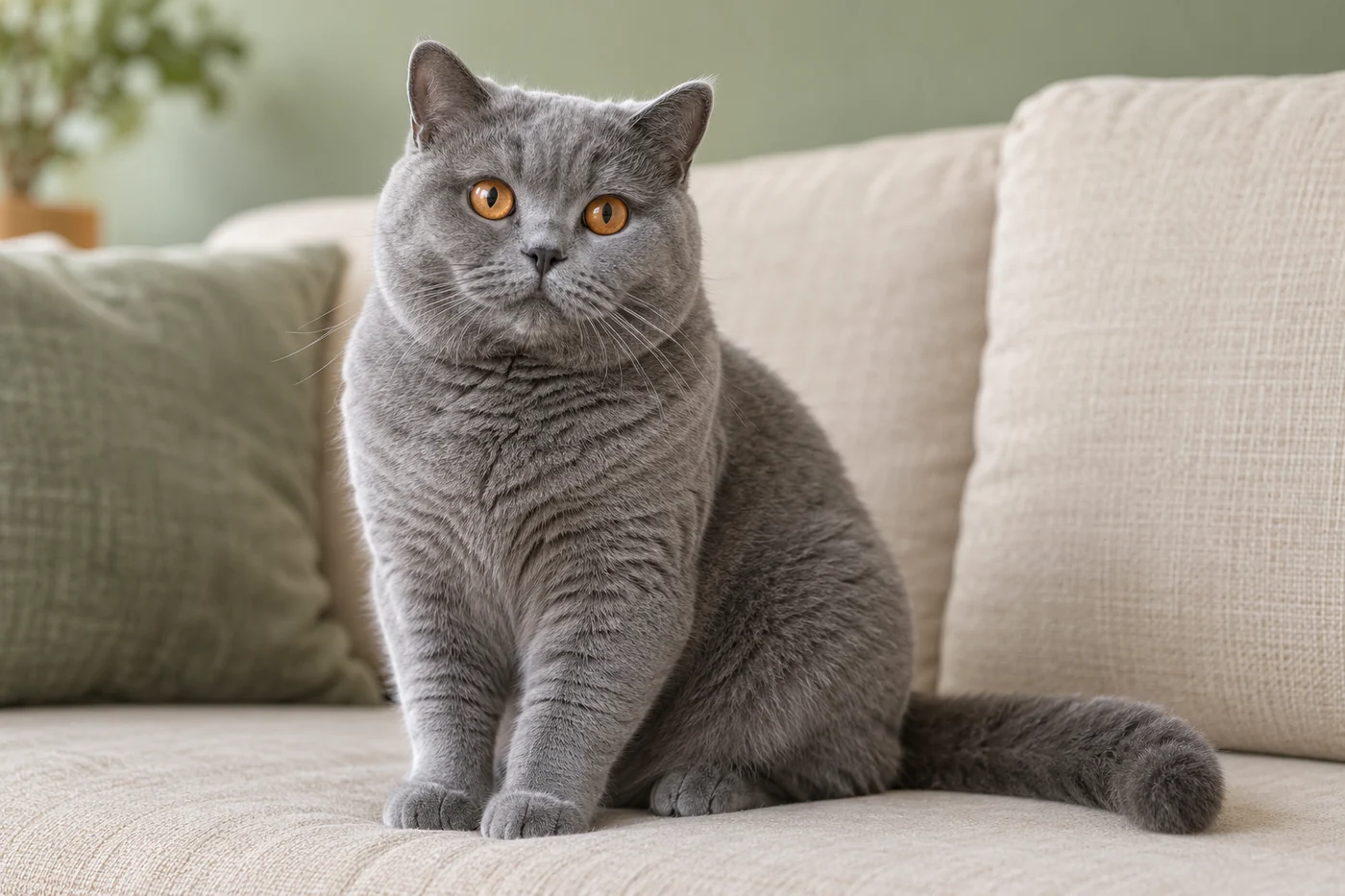
Blue describes dilution of colour; Point describes a particular distribution of pigmentation. Both can occur in the same cat. Keeping the two ideas separate makes colour names and inheritance examples much easier to understand.
Colour made clear
Blue is the colour. Point is the distribution.
- Blue · MLPH
- Dilution of a black pigment base.
- Point · TYR
- Pigmentation concentrated at the extremities.
- Blue Point
- The two characteristics occur together.
Two questions about the same coat
Think of a coat description as several layers. One concerns the type of pigmentation, another its intensity and another the visible pattern. Blue answers a question about dilution, while Point answers a question about where colour is most pronounced. A Blue Point cat is therefore not simply an especially pale blue cat: the name combines two different mechanisms. The Veterinary Genetics Laboratory’s colour overview also shows that other genes contribute to the overall appearance. A single letter can never explain everything visible in a photograph. Source: UC Davis coat-colour overview.
Blue: dilution at the MLPH gene
The familiar dilution variant concerns the MLPH gene and changes the distribution of pigment granules within the hair. The usual notation uses D for the non-dilute version and d for the dilute version. With two d copies, written d/d, a black pigment base appears as Blue. In cat terminology, “blue” means this grey-blue appearance rather than a bright paint-like blue. Ishida and colleagues described the underlying variant. Dilution also affects other basic colours; for example, a red-based colour becomes cream. Source: Ishida et al., MLPH study.
Point: temperature-sensitive pigmentation
The Siamese-type point pattern involves TYR, the gene encoding tyrosinase, an enzyme involved in pigment production. The relevant variant is temperature-sensitive: pigmentation is more pronounced in cooler body regions than in warmer ones. This explains the characteristic darker areas on the face, ears, legs and tail. Lyons and colleagues identified the association with a TYR variant. This biological explanation is not a reason to manipulate a cat’s living temperature to achieve a colour effect. The cat needs a comfortable environment. Source: Lyons et al., TYR study.
C and cˢ: reading the notation
For the simplified point examples here, we use C and cˢ. At the TYR colour locus, C represents full colour and cˢ the Siamese-point variant. cˢ/cˢ produces this point type, whereas C/cˢ denotes a carrier that does not show Siamese point because of that combination. Here C is explicitly not shorthand for a black basic colour. Other TYR variants, including the Burmese variant cᵇ, create additional combinations. Our simple examples deliberately leave those out. Source: UC Davis, Colorpoint Restriction.
Putting the two together: Blue Point
In a suitably black-based cat, the simplified Blue Point combination is d/d at MLPH together with cˢ/cˢ at TYR. One layer dilutes the colour; the other concentrates its stronger expression at the points. The typically blue eyes are part of the Siamese-point appearance, but blue eyes alone do not establish a complete genotype. A photograph cannot reveal hidden carrier variants. White spotting, tabby, orange and other influences can further change a colour description. Source: OMIA, TYR; Source: OMIA, MLPH.
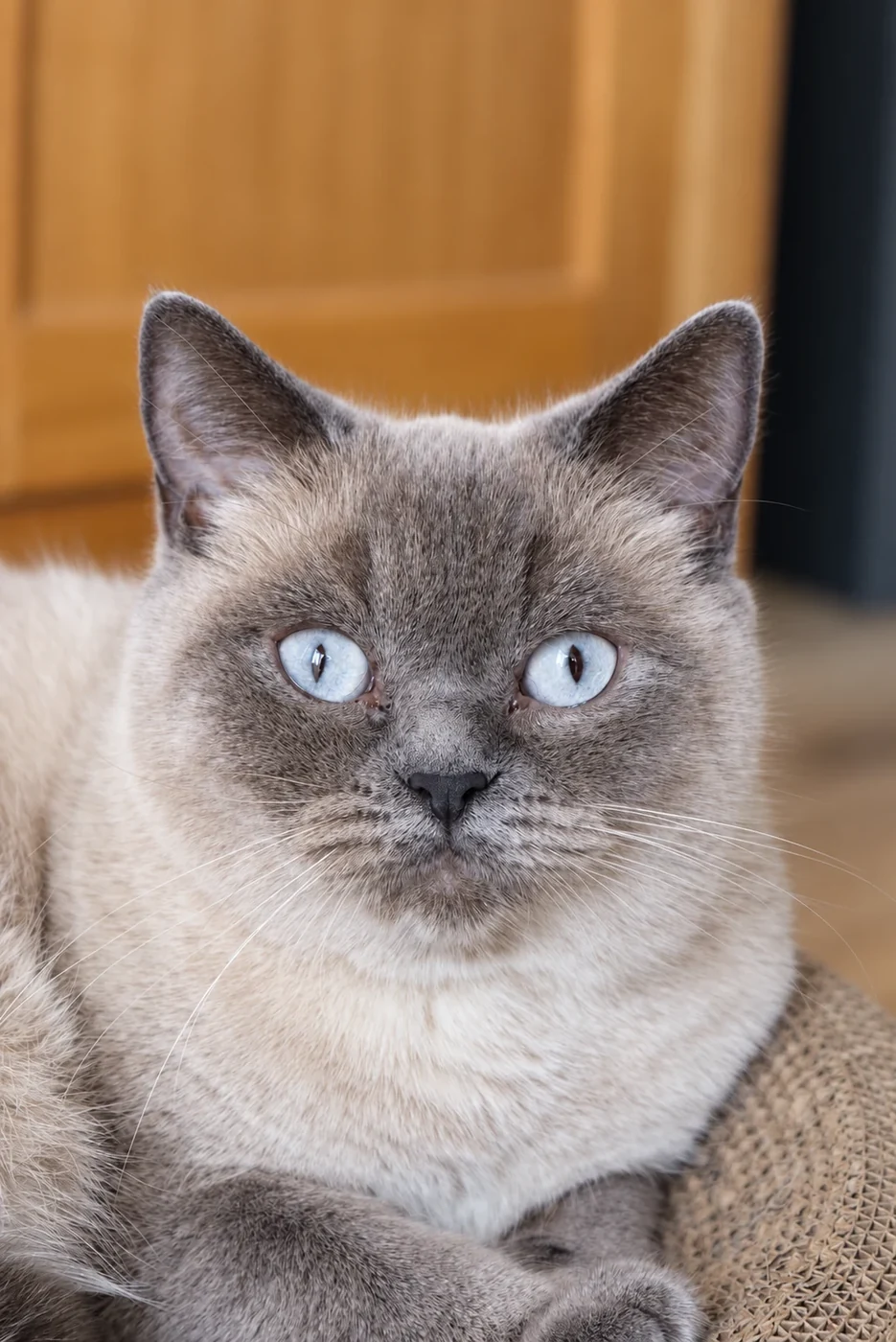
Blue is a general colour example; Blue Point shows Merle. The photographs illustrate coat appearance, not an individual DNA result. Other colour and pattern effects are excluded from the comparison.
What a colour name can and cannot tell you
A colour term helps name an observable feature. It is neither a personality assessment nor a health certificate. For a colour variant, “carrier” first means that a cat can transmit a variant that is not visible in its own appearance; it is not a general synonym for “ill”. A colour test can answer a specific inheritance question, but only about the variants actually examined. Planning a litter therefore requires information about both parents rather than a guess based solely on the mother’s coat. The next article shows how clearly stated assumptions lead to understandable probabilities. Source: UC Davis, Dilute.
When reading a colour name, ask three questions: which basic colour is meant, is it diluted, and which pattern or distribution is added? Keep unknown information explicitly unknown rather than filling a gap from an attractive photograph. That separates description, assumption and established information.