Good to know · British Shorthair
Understanding inheritance step by step
Can a Blue Point cat have solid blue kittens? Yes, under the right conditions. Three deliberately simplified examples show why the other parent’s variants matter and why percentages do not promise a fixed pattern within a litter.
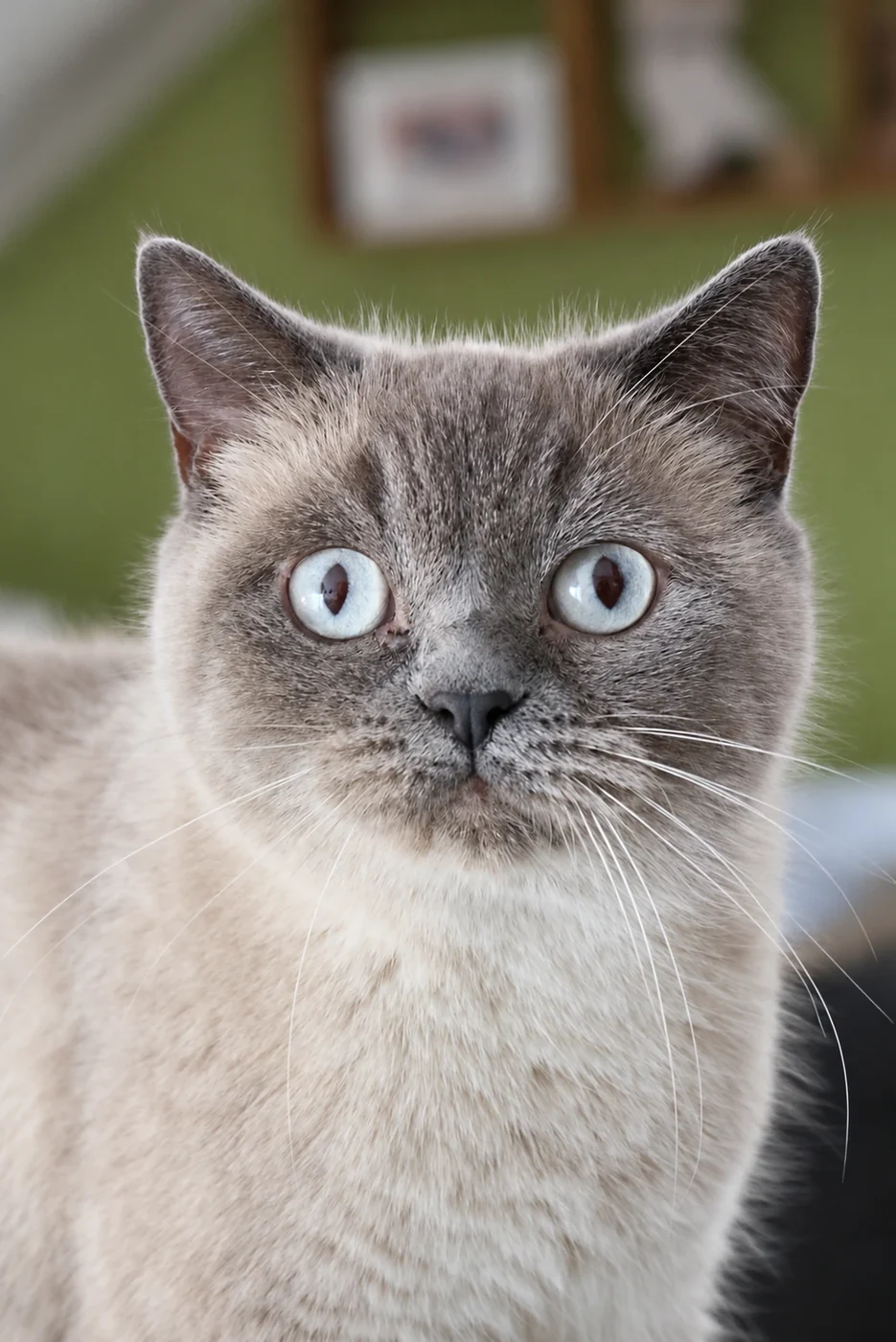
From appearance to inheritance
There is more than meets the eye.
- Phenotype
- What you can observe in a cat.
- Genotype
- The combination of the variants considered.
- Probability
- A chance per kitten, not a fixed litter split.
A useful genetic vocabulary
A gene is a region of DNA, and a variant or allele is one of its possible versions. For the autosomal colour loci considered here, a kitten receives one copy from each parent. Genotype names the combination, while phenotype is the observable trait. Two matching variants are homozygous; two different variants are heterozygous. The terminology sounds more complicated than the calculation: we start with just two entries per gene. Always name the relevant gene or locus so that letters from different systems are not confused. Source: UC Davis genetics glossary.
Recessive does not mean “weak”
In a simple dominant–recessive model, one copy of a recessive variant can remain hidden in the visible appearance while still being passed on. Dominant and recessive describe a relationship between variants at a particular locus; they are not a judgement about the cat or a label for “good” and “bad” genes. In our example, a C/cˢ cat can transmit cˢ even though it does not show Siamese-point markings itself. Whether an offspring is pointed also depends on what the other parent transmits. A single photograph cannot reliably answer that question. Source: NHGRI, recessive inheritance.
The assumptions behind these examples
The following parents are imaginary example cats, not published DNA results for our animals. The mother is assumed to be Blue Point with d/d and cˢ/cˢ; all three example fathers are also d/d. For every example parent, we additionally assume B/B at TYRP1 for a black pigment base and a/a at Agouti for an unpatterned non-point colour. Other colour influences are held fixed: no orange, masking white or silver, additional pattern effects or other TYR variants. This isolates Blue versus Blue Point. As each parent can transmit only d at the dilution locus, every example kitten is d/d. The TYR calculation then distinguishes non-pointed from Siamese-point offspring.
Three fathers, three different outcomes
| Example father at TYR | Possible kittens |
|---|---|
| C/C · solid Blue | 100% C/cˢ: solid Blue, all carrying point |
| C/cˢ · solid Blue, point carrier | 50% C/cˢ: solid Blue, point carrier 50% cˢ/cˢ: Blue Point |
| cˢ/cˢ · Blue Point | 100% cˢ/cˢ: Blue Point |
The mother always transmits cˢ. The first father can provide only C; the second provides C or cˢ with equal probability; the third provides only cˢ. That answers the original question: a pointed mother can have solid blue kittens, provided the father’s genotype supports that outcome. Method: UC Davis, Punnett squares.
The middle example as a Punnett square
| Mother ↓ · father → | C | cˢ |
|---|---|---|
| cˢ | C/cˢ Blue · point carrier | cˢ/cˢ Blue Point |
| cˢ | C/cˢ Blue · point carrier | cˢ/cˢ Blue Point |
Each inside cell represents a combination of possible parental gametes, not one particular baby in a litter. Two cells contain C/cˢ and two contain cˢ/cˢ, giving a 50–50 probability for an individual kitten. The repeated maternal rows are intentionally identical: a cˢ/cˢ mother has no different second variant to distribute at this locus. The square is a way to read the calculation. It does not determine birth order, sex, body weight, personality or health.
Why four kittens do not have to split two and two
With a 50% probability, every second newborn is not automatically pointed. Under our simple model, a litter containing only one of the two colours is also possible. For an illustrative litter of four with independent 50–50 events, the chance of exactly two pointed kittens is 6 in 16, or 37.5%. The chance of four pointed kittens is 1 in 16, or 6.25%. These are calculations, not predictions about a real litter. A small observed group does not contradict inheritance merely because it does not resemble an evenly divided percentage bar.
From an example to a real question
A real pairing requires reliable relevant information about both parents. A targeted colour DNA test can clarify hidden variants; distinguish the animal identification, the variant examined and the result on a laboratory report. A mathematically possible colour outcome is not, by itself, a suitable health or overall breeding decision. Colour is only part of the picture. This page explains the calculation rather than replacing individual breeding or veterinary assessment. Documents for individual animals can be discussed at a personal meeting; the example letters must not be read as an actual test result. Source: UC Davis DNA-test FAQ.